---
title: How to Optimize Your Business for AI Search
description: "The way people search online is changing.\n\nInstead of only turning to Google and typing something like “marketing agency near me,” people can now ask ChatGPT or another AI tool a much more specific question"
image: https://www.jandmaemarketing.com/hubfs/Sunlit%20Minimalist%20Workspace%20with%20AI%20Chat%20Laptop.png
---
[Skip to content](https://www.jandmaemarketing.com/blog/how-to-optimize-your-business-for-ai-search#main-content)
[](https://www.jandmaemarketing.com)
- [About](https://www.jandmaemarketing.com/about)
- [Approach](https://www.jandmaemarketing.com/our-approach)
- [Services](https://www.jandmaemarketing.com/services)
- [Blog](https://www.jandmaemarketing.com/blog)
- [Workshops](https://www.jandmaemarketing.com/workshops)
Open main navigation
Close main navigation
- [About](https://www.jandmaemarketing.com/about)
- [Approach](https://www.jandmaemarketing.com/our-approach)
- [Services](https://www.jandmaemarketing.com/services)
- [Blog](https://www.jandmaemarketing.com/blog)
- [Workshops](https://www.jandmaemarketing.com/workshops)
- [Contact Us](https://www.jandmaemarketing.com/contact-us)
[Contact Us](https://www.jandmaemarketing.com/contact-us)
[All posts](https://www.jandmaemarketing.com/blog/all)
August 14, 2026
# How to Optimize Your Business for AI Search
 By J & Mae Marketing · 3 minute read
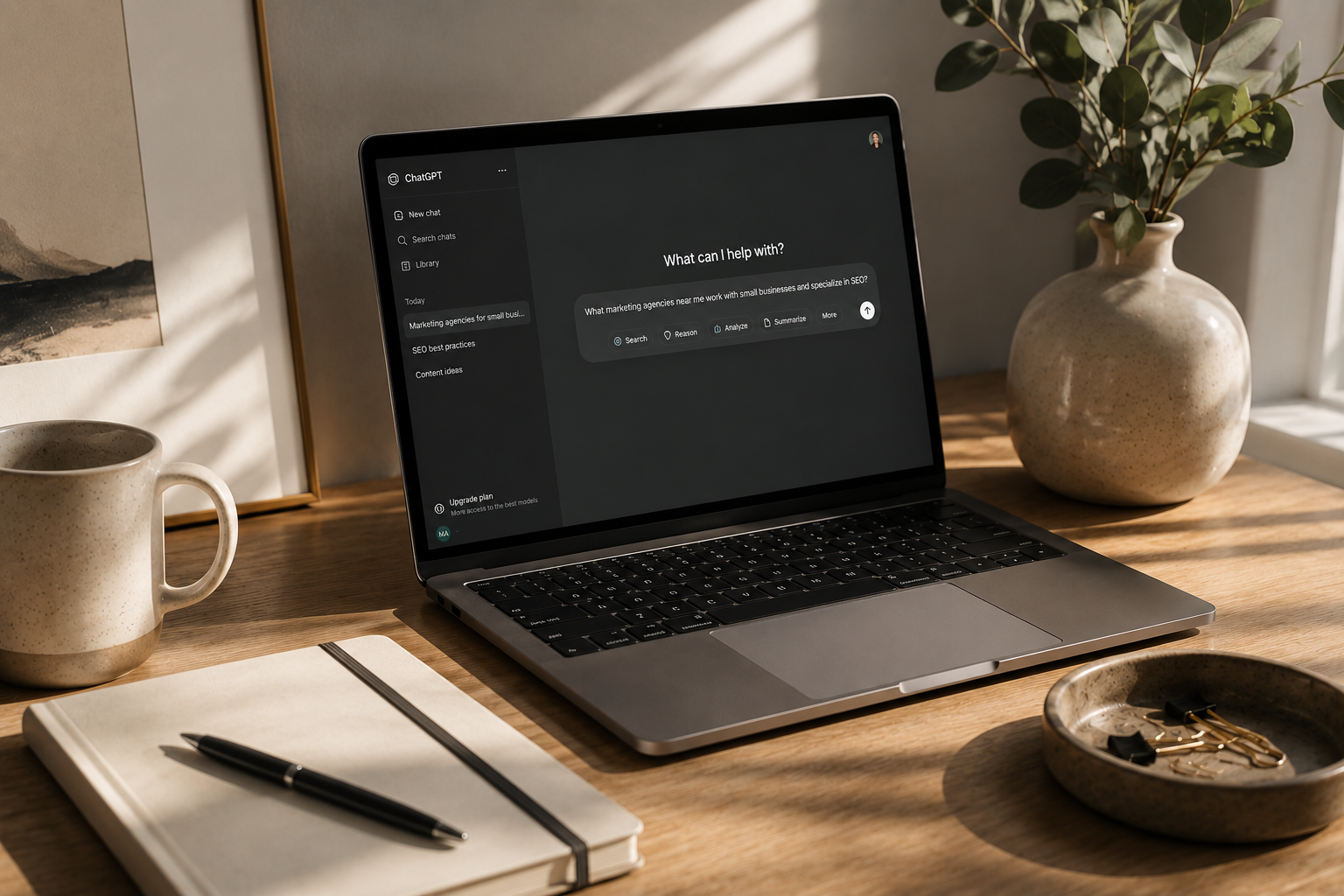
The way people search online is changing.
Instead of only turning to Google and typing something like "marketing agency near me," people can now ask ChatGPT or another AI tool a much more specific question: "What marketing agencies near me work with small businesses and specialize in SEO?"
That shift has introduced a new term into the marketing conversation: AEO, or Answer Engine Optimization, sometimes referred to as GEO, Generative Engine Optimization.
AEO is essentially about making it easier for search engines and AI tools to understand your business, your expertise, and the information you provide.
The good news? You do not need to throw out your SEO strategy and start over. In fact, Google specifically says that existing SEO best practices remain relevant to its generative AI search experiences.
So, what should businesses be doing now?
## 1. Make Your Website Crystal Clear
Start with the basics. Can someone quickly understand what you do, who you serve, and where you work?
Your website should clearly communicate your services, expertise, location, team, and the problems you help solve.
Specificity matters. A headline like "Helping Businesses Grow" says very little. "Marketing Strategy, SEO, and Content for Small Businesses in New Hampshire" gives much more context.
## 2. Answer the Questions Your Customers Actually Ask
Think beyond short keywords.
What questions come up on sales calls? What do customers ask before working with you? What do people misunderstand about your industry?
Those questions are great starting points for blogs, FAQs, and service-page content.
Google's current guidance for AI search continues to emphasize creating original, useful content that actually satisfies what people are looking for.
## 3. Bring Your Own Expertise to Your Content
With so much generic content online, there is value in creating something only **you** could write.
- Share examples.
- Explain what you're seeing in your industry.
- Talk about common mistakes.
- Answer questions based on conversations you've actually had with customers.
Google recommends creating unique content that adds value rather than simply producing more commodity content, especially as generative AI makes mass content creation easier.
## 4. Build Your Presence Beyond Your Website
Your digital footprint is bigger than your website.
Keep business information consistent and current across places like your Google Business Profile, professional directories, social profiles, and industry associations.
Reviews, press coverage, backlinks, podcasts, speaking engagements, and other credible mentions can also strengthen your online presence.
The goal is to create a clear picture of **who you are, what you do, and what you're known for.**
## 5. Get the Technical Basics Right
AI visibility also has a technical side.
Make sure search engines can crawl and index your website. Structured data, also known as schema markup, can provide search engines with additional machine-readable information about a page's content. Google notes that structured data can help its systems understand page content, although it does not guarantee visibility or rankings.
If visibility in ChatGPT search matters to your business, make sure your website isn't blocking OpenAI's OAI-SearchBot. OpenAI identifies allowing this crawler as an important step for making public website content discoverable in ChatGPT search.
## Want to Work Through This Together?
I'm running a workshop on exactly this: **Get Found, Get Cited: SEO & AEO for the AI Search Era**, on Thursday, October 15th, at 10:00 AM EST at [Pink Clover Studio](https://pinkcloverstudio.com/) in Windham, NH.
Over about an hour and a half, we'll cover how SEO and AEO work together, simple keyword research and search intent, ways to optimize your site for both Google and AI search, how to structure content so it's easier to find and cite, and Google Business Profile best practices for local visibility.
No prior SEO knowledge needed, and you'll leave with a checklist you can actually use. Tickets are $15. [See the details and save your seat](https://www.jandmaemarketing.com/workshops).
## SEO Isn't Going Away
AEO does not mean SEO is dead.
Think of it as an evolution of search strategy.
The fundamentals still matter: create a strong website, publish genuinely useful content, establish expertise, build authority, and make it easy for search engines to understand your business.
Now we're thinking about those fundamentals across both traditional search results **and** AI-generated answers.
Search will keep changing. Your job isn't to chase every new acronym. It's to make sure that wherever your customers are searching, your business has a strong chance of being found.
### Not Sure Where Your Business Stands?
Most small businesses are closer than they think. Usually it's a few gaps: unclear positioning on the homepage, content that doesn't answer real customer questions, or business information that's drifted out of sync across directories.
That's the work we do every day for clients across brand, content, SEO, and reporting. If you want a clear picture of where your business shows up now and what to fix first, [get in touch](https://www.jandmaemarketing.com/contact-us).
Share [linkedin-in icon](http://www.linkedin.com/shareArticle?mini=true&url=https://www.jandmaemarketing.com/blog/how-to-optimize-your-business-for-ai-search) [facebook-f icon](http://www.facebook.com/share.php?u=https://www.jandmaemarketing.com/blog/how-to-optimize-your-business-for-ai-search) [envelope icon](mailto:?body=https://www.jandmaemarketing.com/blog/how-to-optimize-your-business-for-ai-search)
[](https://www.jandmaemarketing.com/)
Stop chasing. Start shining.
## Contact
221 Main Street, Suite N
Nashua, NH 03060
- [603-850-3799](tel:+16038503799)
- [info@jandmaemarketing.com](mailto:info@jandmaemarketing.com)
## Pages
- [Home](https://www.jandmaemarketing.com/)
- [About](https://www.jandmaemarketing.com/about)
- [Approach](https://www.jandmaemarketing.com/our-approach)
- [Services](https://www.jandmaemarketing.com/services)
- [Contact](https://www.jandmaemarketing.com/contact-us)
## Resources
- [Blog](https://www.jandmaemarketing.com/blog)
- [Workshops](https://www.jandmaemarketing.com/workshops)
- [Newsletter](https://share-na2.hsforms.com/1Mm7jf-p_Ty2hmBBUzT3nhw41fv2c)
© 2026 J & Mae Marketing LLC
[Privacy Policy](https://www.jandmaemarketing.com/privacy-policy) Cookie Settings
Cookie Settings
The J & Mae newsletter
## Marketing ideas *worth keeping up with.*
Practical insights, useful resources, and occasional updates from the agency. Once a month, and you can unsubscribe any time.
Loading the form.
By subscribing you agree to receive marketing emails from J & Mae Marketing. We send about once a month, and you can unsubscribe any time. See our [Privacy Policy](https://www.jandmaemarketing.com/privacy-policy).
```json
{
"@context" : "https://schema.org",
"@type" : "BlogPosting",
"author" : {
"@type" : "Person",
"name" : "J & Mae Marketing",
"url" : "https://www.jandmaemarketing.com/blog/author/j-mae-marketing"
},
"dateModified" : "2026-08-15T16:08:28.893Z",
"datePublished" : "2026-08-14T03:49:58.000Z",
"headline" : "How to Optimize Your Business for AI Search",
"image" : [ "https://www.jandmaemarketing.com/hubfs/Sunlit%20Minimalist%20Workspace%20with%20AI%20Chat%20Laptop.png" ],
"mainEntityOfPage" : {
"@id" : "https://www.jandmaemarketing.com/blog/how-to-optimize-your-business-for-ai-search",
"@type" : "WebPage"
},
"publisher" : {
"@type" : "Organization",
"logo" : {
"@type" : "ImageObject",
"url" : "https://www.jandmaemarketing.com/hubfs/J_and_Mae_Marketing_logo_high_res-1.png"
},
"name" : "J & Mae Marketing"
}
}
```
```json
{
"@context" : "http://schema.org",
"@type" : "Article",
"headline" : "How to Optimize Your Business for AI Search",
"image": "https://244284420.fs1.hubspotusercontent-na2.net/hubfs/244284420/Sunlit%20Minimalist%20Workspace%20with%20AI%20Chat%20Laptop.png",
"author": {
"@type": "Person",
"name": ["J & Mae Marketing"]
},
"publisher": {
"@type": "Organization",
"name": "J & Mae Marketing",
"logo": {
"@type": "ImageObject",
"url": "https://244284420.fs1.hubspotusercontent-na2.net/hubfs/244284420/J_and_Mae_Marketing_logo_high_res-1.png"
}
},
"description": "The way people search online is changing.
Instead of only turning to Google and typing something like “marketing agency near me,” people can now ask ChatGPT or another AI tool a much more specific question",
"datePublished": "2026-08-14T03:49:58+0000",
"url" : "https://www.jandmaemarketing.com/blog/how-to-optimize-your-business-for-ai-search"
}
```